
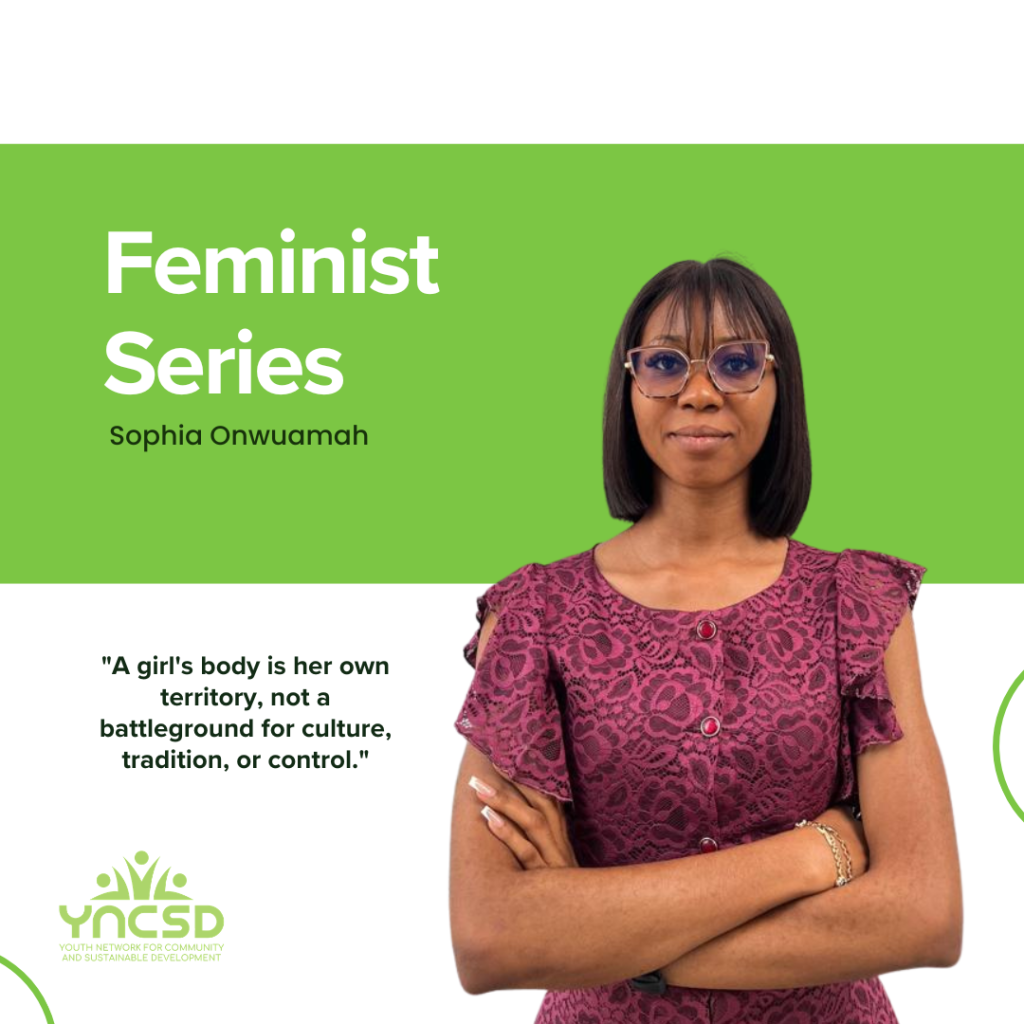
by Sophia Onwuamah
“A girl’s body is her own territory, not a battleground for culture, tradition, or control. When we cut her, bind her, or marry her off before she’s ready, we’re not preserving tradition, we’re waging war on her future.”
Let’s be real for a minute. A young girl’s body is many things. It is a vessel for her dreams, her strength, her intelligence, and her potential. It is hers, and hers alone.
Imagine being held down at age seven while adults you trust use a blade on the most intimate part of your body. Imagine being told at thirteen that school is over because you’re now someone’s wife. For millions of girls across Nigeria and around the world, this isn’t imagination; this is a reality.
Female Genital Mutilation (FGM) and child marriage are not abstract statistics. They are brutal violations happening to real girls with dreams, potential, and rights. In Nigeria alone, approximately 20 million women and girls have undergone FGM, while 43% of girls are married before age 18. These harmful practices don’t just hurt; they kill, traumatise, and systematically strip away futures.
But here’s the truth that should fuel our fight: these practices are not inevitable. They are choices communities make, and communities can change them. This is about gender justice, human rights, and recognising that her body is not a battlefield for outdated traditions.
FGM doesn’t exist in a vacuum. It’s part of a larger ecosystem of gender-based violence that includes child marriage. Both practices share the same rotten root: the belief that girls’ bodies and futures are not theirs to control. The message is clear: whether through cutting or coercing into marriage, society treats girls’ bodies as property to be managed, not as vessels of potential to be protected.
Let’s address the elephant in the room: culture. Defenders of FGM and child marriage often invoke “tradition” and “culture” as justification. However, culture is not static, and tradition is not sacred simply because it’s old. Our ancestors once accepted slavery, denied women education, and believed the earth was flat. We evolved. Yes! We can evolve again.
Progress has been made with the VAPP Act (2015), which prohibits FGM federally and has been adopted by 36 states and the FCT. The Child Rights Act (2003) sets the minimum marriage age at 18, but only 24 states have domesticated it, leaving gaps. Laws on paper do not equal protection in practice. WHY? Enforcement is weak, awareness is low, and cultural resistance is high. Many communities are unaware of these laws or fail to respect them because they weren’t involved in their creation.
You cannot shame or legislate away deeply held beliefs. You cannot protect girls without transforming the communities they live in. Sustainable change must come from within communities, led by communities, for communities. This is called the community-led approach, and it works because it challenges the social norms that sustain harmful practices.
FGM and child marriage are symptoms of a larger disease: gender inequality. They exist in societies that value boys over girls, men over women, and male pleasure over female autonomy. Change can feel overwhelming, but it starts with each of us taking responsibility.
Every girl deserves to dream without limits, to learn without interruption, to choose her own path. When we cut her body or force her into marriage, we don’t just violate her rights, we steal her potential, her voice, her future. This fight demands that we prioritise girls’ rights over patriarchal comfort. It needs sustained commitment, resources, and courage.
Now is the time! We are the ones who can end centuries-old practices that serve no purpose but to control and harm. We are the ones who can redefine tradition to honour girls, not hurt them. We are the ones who can build a Nigeria and a world where every girl’s body is hers and not a battlefield for obsolete beliefs.
Culture belongs to the living. It is ours to shape. Let us shape a Nigerian culture that celebrates our girls whole, healthy, educated, and free. The time is now! The responsibility is ours! Let’s protect futures, not destroy them!
“When communities rise, girls thrive. When girls thrive, nations flourish.”