
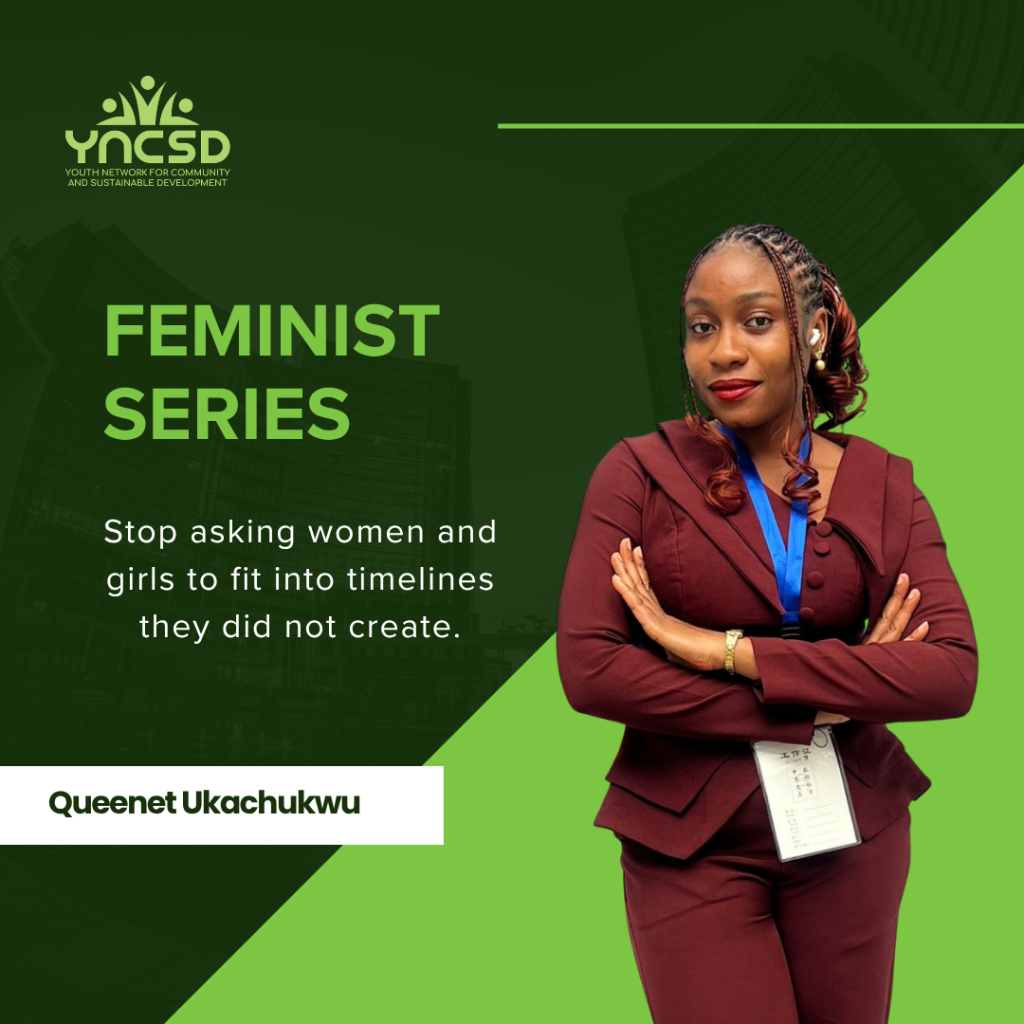
by Queenet Ukachukwu
Aku had a fire in her.
From a young age, she knew she was meant for more. She dreamed of building things, leading movements, changing systems, running empires and creating impact that would outlive her. While others were told to prepare for what comes next, Aku was already building what comes now. She was not confused about her purpose; she was clear, bold, and certain.
But the world around her had a different script. Not written for her. Not with her in mind. But enforced on her anyway.
“Focus on looking presentable.”
“A girl should not be too ambitious.”
“By this age, you should be settled.”
And quietly, a system of expectations began to form around her life, a timeline she never agreed to, but was expected to follow.
At school, she was told to aim high. At home, she was told not to aim too high.
In public, she was praised for her intelligence. In private, she was reminded that intelligence alone was not enough.
Slowly, Aku began to notice something bigger than herself: a pattern. Girls were constantly being measured. Not just by achievement, but by timing. Not just by dreams, but by when those dreams were acceptable.
And when girls did not fit the timeline, they were corrected. They were called stubborn, reckless, too independent and shamed for choices that were never meant to be policed.
Aku watched it happen around her. Girls are pushed into adulthood too early, and some are forced into responsibilities, including marriage, before they have even fully understood their own identities. In places like Kaduna, conversations around child marriage revealed a painful truth: for many girls, the world still decides when their childhood ends, and what their future must look like, without their consent.
It’s all connected. Different forms of the same control. Different stages of the same expectation. And then Aku felt it happen to her too.
The pressure didn’t always come loudly. Sometimes it came as a concern. Sometimes as jokes. Sometimes as “advice.”
“You are getting older, and there’s no time”
“Don’t focus too much on your career.”
“Life is not only about ambition.”
So she adjusted. She softened. She shrank. She began to measure her life not by what she wanted, but by whether she was on track.
Until one day, she paused and asked herself a hard question: On track for who?
Because nothing about her life felt like hers anymore; it felt assigned.
As Chimamanda Ngozi Adichie said:
“We teach girls to shrink themselves, to make themselves smaller.”
Aku realised she was not just shrinking, she was being shaped. Shaped by expectations. Shaped by timelines. Shaped by systems that decide what a successful woman should look like before she ever gets to choose.
But feminism told her something different. It told her she was not a checklist. She was not a deadline. She was not a project to be completed on time. And more importantly, she was not alone in this experience.
Because this is not just Aku’s story.
It is the story of many girls and women whose lives are structured by expectations they did not design. From subtle pressures about when to settle, to harmful practices like child marriage that still affect girls in parts of Nigeria, the message is often the same: your life is not entirely yours to decide.
SRHR changes that narrative. Sexual and Reproductive Health and Rights is not only about services, but it is also about power. It is about agency. It is about the right to decide when to grow up, when to have children, if to marry, when to marry, or not at all. It is about defining a meaningful life without fear or punishment.
As bell hooks reminds us:
“Feminism is for everybody.”
That means accountability sits with everyone, including men and boys, who are also shaped by these systems and must actively unlearn, challenge, and refuse to enforce them, because these expectations are not maintained by women alone; they are sustained by society as a whole.
It didn’t happen all at once. It happened one evening at a family gathering. Aku had just shared an update about a project she was leading when someone laughed and said, “All these achievements are good, but when will we come and eat rice at your wedding?”
The room filled with knowing smiles, a few nods, and that familiar look of concern disguised as love. Later that night, while scrolling through her phone, she saw a story about a young girl in Kaduna who was pulled out of school because it was time for her to marry. And it hit her sharply.
Different lives, different circumstances, but the same quiet message: your timeline is not yours. At that moment, Aku realised that whether loud or subtle, polished or forced, the pressure was part of the same system, one that decides for girls and women when to become, what to become, and how to live.
Aku is still becoming, but now she understands something powerful; she was never behind.
She was never late. She was never off track. She was simply being asked to live a life that was never designed with her freedom in mind, and she is choosing differently now.
So this is the call:
To feminists, keep telling stories and doing the work that exposes these systems, not just the symptoms.
To advocates, connect the dots between everyday pressure and structural harm, including child marriage and SRHR violations.
To men and boys, refuse to be gatekeepers of women’s timelines. Become allies in dismantling them.
To everyone, stop asking women and girls to fit into timelines they did not create.
Because the goal is not for women to arrive on time.
The goal is for women to finally own the clock. Let us gain gender equity.