by Marvellous Obot
On May 17 every year, the world commemorates the International Day Against Homophobia, Biphobia, Intersexism, and Transphobia (IDAHOBIT). The day marks a historic milestone: the 1990 decision by the World Health Organisation to remove homosexuality from its list of mental disorders. Since then, IDAHOBIT has grown into a global movement for dignity, equality, and freedom for people of diverse sexual orientations, gender identities, gender expressions, and sex characteristics.
The 2026 global theme, “At the heart of democracy,” is both timely and urgent. It reminds the world that democracy is not only about elections or political institutions; it is about whether every person can live freely, safely, and equally under the law. A society cannot genuinely claim to be democratic while systematically excluding, criminalising, or silencing minorities.
Across the globe, LGBTQIA+ people continue to face violence, discrimination, arbitrary arrests, online harassment, exclusion from healthcare, and barriers to education and employment. In many countries, these realities are reinforced by laws that treat people’s identities as crimes rather than human experiences deserving protection and respect. Such environments weaken democratic culture because they normalise fear, restrict civic participation, and erode the principle that all citizens deserve equal protection under the law.
For countries like Nigeria, this moment presents a leadership opportunity. Nigeria is Africa’s most populous country and one of the continent’s most influential democracies. Its leadership on human rights issues carries regional significance. Upholding the rights of gender and sexual minorities should not be viewed as a foreign agenda or a threat to culture; rather, it should be understood as a constitutional and human rights imperative rooted in dignity, justice, and equal citizenship.
Protecting LGBTQIA+ rights does not require abandoning cultural or religious values. It requires rejecting violence, discrimination, blackmail, mob justice, and state-sanctioned persecution. Every Nigerian deserves the right to safety, access to healthcare, freedom from torture, and protection under the law, regardless of identity. Democracies become stronger when they protect minorities, not when they sacrifice them to populism or political expediency.
Recent developments in Senegal demonstrate the dangerous consequences of moving in the opposite direction. In April 2026, Senegal enacted a harsher anti-LGBTQ law that doubled prison sentences for same-sex relations and criminalised the so-called “promotion” of homosexuality. Human rights organisations and UN officials have warned that the law undermines freedom of expression, dignity, association, and access to healthcare.
The impact has already been severe. Reports indicate increased arrests, widespread fear, forced HIV testing, and shrinking access to HIV prevention services as vulnerable communities go underground to avoid persecution. Health experts warn that the law risks reversing decades of public health progress in Senegal. This is why criminalisation must be recognised not only as a legal issue, but also as a public health crisis and a direct violation of fundamental human rights.
Africa’s future cannot be built on exclusion. History has repeatedly shown that societies flourish when diversity is protected, and citizens are empowered to participate fully in public life. Young Africans today are increasingly demanding accountable governance, social justice, inclusion, and respect for human dignity. LGBTQIA+ rights are part of that broader democratic conversation.
The path forward requires courage, empathy, and sustained dialogue. Governments should repeal laws that criminalise identity and expression, strengthen protections against violence and discrimination, and ensure equitable access to healthcare and justice systems. Civil society organisations, faith leaders, educators, and media institutions also have a role to play in promoting evidence-based conversations that prioritise humanity over fearmongering.
For Nigeria specifically, progress can begin with practical steps: ending arbitrary arrests and abuse, strengthening civic education on human rights, protecting freedom of association, expanding inclusive healthcare services, and creating safe spaces for dialogue across communities. Democracy is not weakened by inclusion; it is deepened by it.
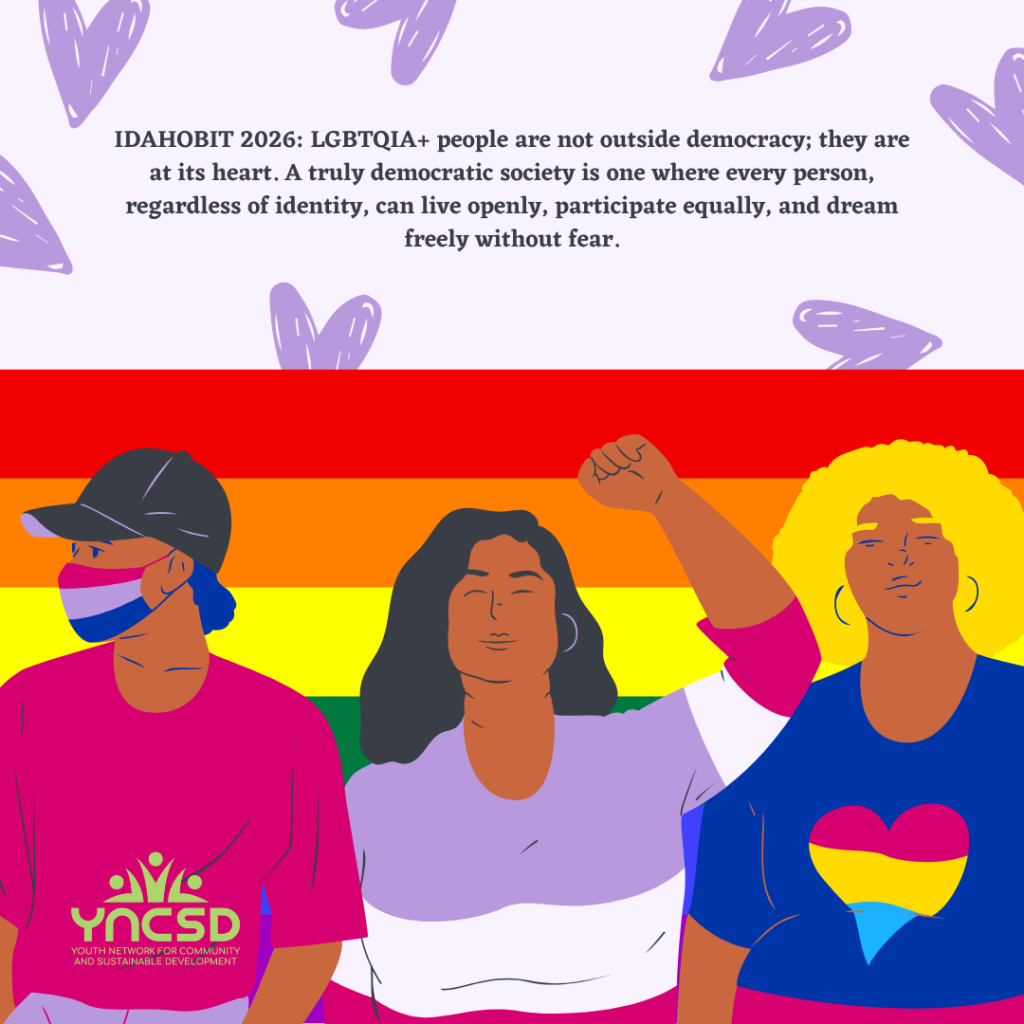
As the world marks IDAHOBIT 2026, the message is clear: LGBTQIA+ people are not outside democracy; they are at its heart. A truly democratic society is one where every person, regardless of identity, can live openly, participate equally, and dream freely without fear.
The future of democracy depends on it.