Why abortion and reproductive justice must account for intersecting experiences of gender, disability, age, sexuality, intersex status, socioeconomic inequality and other forms of marginalisation.
Every September 28, people across the world come together to mark International Safe Abortion Day and demand something that should not be controversial: access to safe, legal and stigma-free abortion care.
This year’s theme, “Solidarity in Action: Advance Reproductive Justice and Urgently Strengthen Health Systems for Comprehensive Abortion Care,” speaks directly to the work we do at the Youth Network for Community and Sustainable Development (YNCSD).
In Nigeria, the reality is stark. Restrictive laws, stigma, misinformation and gaps in health services do not eliminate the need for abortion. They push people into situations where accessing care becomes more difficult, dangerous and costly. Unsafe abortion continues to contribute significantly to maternal deaths, while Nigeria carries one of the world’s heaviest maternal mortality burdens. We cannot talk seriously about reproductive justice without talking about these realities. We also cannot talk about abortion care as though everyone experiences the health system in the same way.
Reproductive justice means looking at the whole picture
As an intersectional feminist, intersex and queer rights activist, youth advocate and SRHR advocate, I believe our conversations about abortion have to move beyond treating it as a binary women’s issue. That framing leaves people out. Women and girls absolutely need access to safe and comprehensive abortion care. But they are not the only people who may need it. Gender non-conforming people, transgender men and some intersex people can also become pregnant and need reproductive healthcare. Their experiences are often missing from policy discussions, service design, advocacy spaces and public conversations.
When we reduce abortion to a “women’s issue”, we can unintentionally reproduce the same exclusions we claim to be fighting. For gender-diverse people, seeking sexual and reproductive healthcare can mean dealing with discrimination, misgendering, institutional erasure and providers who are not equipped to offer respectful care. For intersex people, the conversation must also recognise that reproductive justice is about bodily autonomy and the right to make decisions about one’s own body, not simply about fitting people into male or female categories.
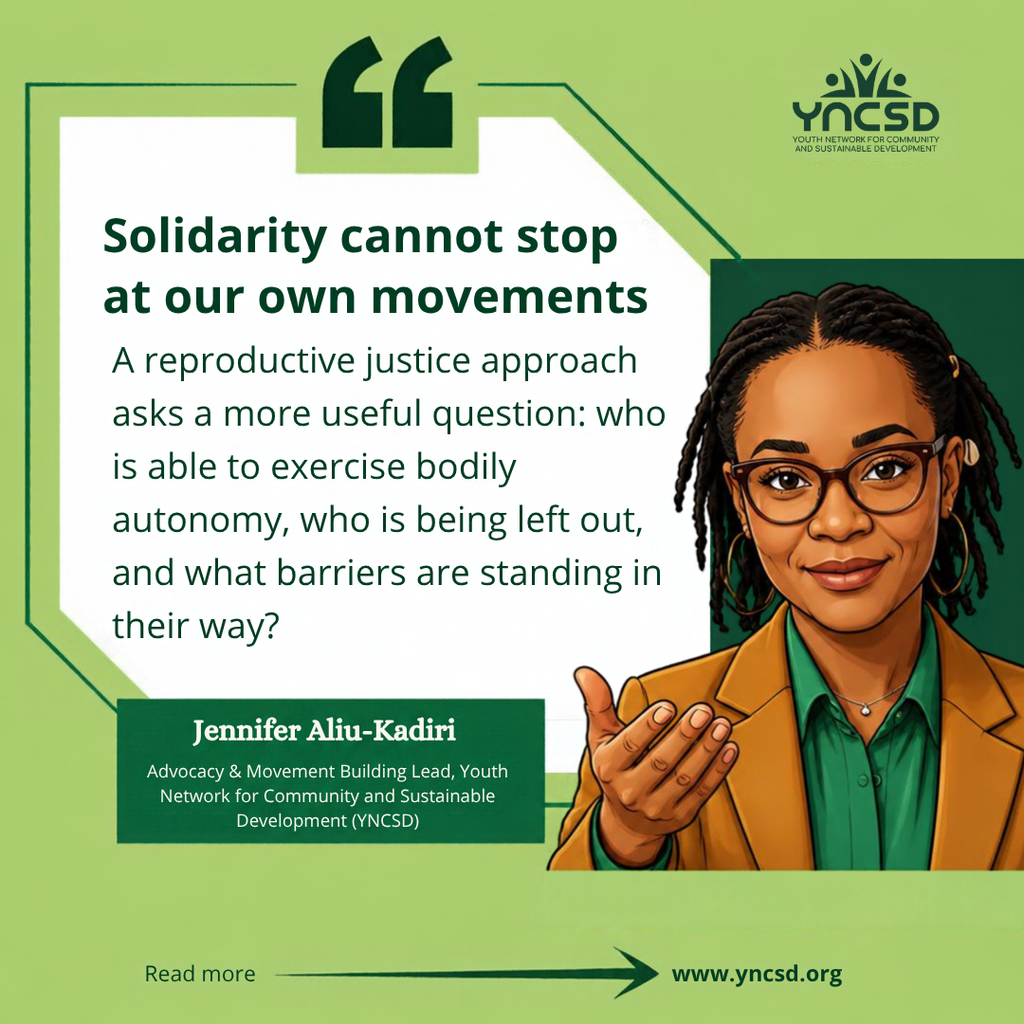
A reproductive justice approach asks a more useful question: who is able to exercise bodily autonomy, who is being left out, and what barriers are standing in their way? The same health system can present very different barriers depending on who is trying to use it.
For people with disabilities, a supposedly accessible service may still be impossible to navigate. A clinic might have a ramp but no accessible information. A provider might offer treatment but communicate in ways that exclude someone with a hearing, intellectual or cognitive disability. Someone else may be overwhelmed by bright lights, noise, crowded waiting rooms or unfamiliar procedures. Neurodivergent people can face their own set of barriers, from sensory overload and rigid systems to medical infantilisation and information that assumes everyone processes and understands information in the same way.
These aren’t side issues. They are part of whether someone can actually exercise bodily autonomy.
That is why reproductive justice sits at the intersection of health, gender equality, disability rights, youth rights, social inclusion and human rights. It speaks directly to SDG 3 on good health and well-being, including universal access to sexual and reproductive healthcare, and SDG 5 on gender equality, including universal access to sexual and reproductive health and reproductive rights.
It also connects clearly with SDG 10, which calls for the social, economic and political inclusion of all people and action to reduce discriminatory laws, policies and practices.
For us, this means that inclusion cannot simply be a statement at the beginning of a strategy document. It has to shape who is seen, who is heard, who is represented in data, who designs services and who gets to make decisions about their own body.
Solidarity cannot stop at our own movements
The struggle for abortion access has never and does not exist in isolation. It connects to the fight against gender-based violence, early and forced marriage, Female and Intersex Genital Mutilation and Cutting (I&FGM/C), discrimination against people with disabilities, and the many forms of violence that limit people’s ability to make decisions about their bodies and futures.
Consider a girl whose education is interrupted by early marriage. Consider a woman who becomes pregnant after sexual violence and has no meaningful pathway to report what happened or access the care she needs. Consider someone living with a disability who cannot access a clinic independently or obtain reproductive health information in a format they can use. These are never separate struggles. They are connected by questions of power, autonomy, access and whose choices are treated as worthy of respect. That is why solidarity has to mean more than showing up for one campaign activity, webinar or one day of action. It means recognising the connections between our movements and making room for each other in and within the work.
This is also where the Sustainable Development Goals, SDG 16 matters. The goal calls for inclusive, participatory and representative decision-making, as well as non-discriminatory laws and policies. Reproductive justice cannot be separated from the question of who gets to participate in shaping the policies and institutions that govern people’s lives. At YNCSD, we see movement building as part of this process. We work with young people, civil society organisations, media actors and community stakeholders because changing policy is only one part of changing people’s realities. Public narratives matter. Community knowledge matters. The people most affected by these issues must have a voice in shaping the solutions.
Health systems have to work for real people
Someone may technically have access to healthcare but still be unable to reach a facility, afford the service, communicate with a provider, understand the information being given to them or receive care without judgment. Health systems need the resources, knowledge and confidence to provide comprehensive abortion care. Providers need appropriate training and support. Information needs to be available in formats people can actually use. Services need to be physically accessible and responsive to different needs. This is where advocacy and information become practical tools for sustainable change.
YNCSD launched SafeBank, a centralised digital SRHR knowledge repository designed to make relevant information and advocacy resources easier to access. It brings together safe abortion advocacy guidelines, data and educational resources that young advocates can use in their work. We see accessible information as part of health-system strengthening, not an afterthought. That means continuing to improve how information is presented, including through plain-language resources, accessible digital formats and approaches that are more responsive to neurodivergent users and people with disabilities. Where self-managed abortion is legal, information should also help people understand their options and know when and where to seek additional care. People cannot advocate for better services if the information they need is hidden behind technical language, inaccessible platforms or stigma.
Solidarity also means building the partnerships needed for change
No movement can carry this work alone. Reproductive justice requires health workers, young people, feminist movements, disability rights advocates, intersex and queer activists, researchers, policymakers, media practitioners, community leaders and civil society organisations to work together without erasing the differences in our experiences.
That is where SDG 17, Partnerships for the Goals, becomes especially relevant for the movement and the frontliners. The UN recognises multi-stakeholder partnerships as a means of sharing knowledge, expertise, technology and financial resources, while specifically encouraging effective partnerships that include civil society. For movements like ours, partnership cannot simply mean having more organisations in the room. It has to mean sharing power, resources, knowledge and visibility.
It means supporting grassroots organisations and emerging activists, not only the organisations that already have access to decision-making spaces. It means creating partnerships where lived experience is treated as expertise. It means flexible funding that allows movements to organise, respond to emerging issues, sustain their people and build long-term resilience. We need partnerships that do more than deliver just projects. We need partnerships that strengthen movements.
What our team is seeing on ground at the Frontline
Queenet Ukachukwu, Head of Programmes and Operations
“Strengthening health systems means building infrastructure that serves everyone without exception. We must train and equip healthcare providers to deliver compassionate, non-judgmental and trauma-informed care that respects gender diversity and accommodates physical and cognitive disabilities. Comprehensive abortion care must be universally accessible and safe.”
Okolo Ekene Peter, Technical Delivery and Impact Lead
“Data and evidence-based research are the backbone of effective policy negotiation. To advance reproductive justice, our data collection must be disaggregated to capture the distinct realities of disabled people, GNC individuals and marginalised youth. Presenting this full picture to policymakers is essential to dismantling punitive laws and building equitable systems.”
Moyinoluwa Daniel, Communications Officer
“The media plays a pivotal role in shaping societal attitudes. To advance reproductive justice, we must change the narrative away from rigid binaries and harmful stereotypes. By using inclusive language and amplifying the lived experiences of disabled, neurodivergent and gender-diverse individuals, we can demystify abortion and foster true collective solidarity.”
Sophia Onwuamah, Programme Associate
“Our grassroots engagement shows us every day how interlocking identities shape a person’s ability to access care. Ensuring access to comprehensive abortion care requires breaking down every barrier, whether financial, physical, cognitive or social. We are equipping young leaders across all backgrounds to demand a future where bodily autonomy is a guaranteed reality for every body.”
Their reflections point to what we already know from movement work: there is no single intervention that will fix an unequal system. We need policy change. We need better services. We need data that doesn’t erase people. We need communications that don’t reinforce stigma. We need communities that can organise, advocate and hold institutions accountable;and we need the people most affected by these systems at the centre of that work.
From solidarity to action
As we mark International Safe Abortion Day, YNCSD is calling on policymakers, healthcare providers, civil society organisations and movement allies to move beyond statements of support and take concrete steps.
1. Remove legal and policy barriers to abortion care.
Review restrictive laws and policies that undermine bodily autonomy and contribute to unsafe abortion, and move towards rights-based frameworks that protect access to comprehensive care.
2. Build health systems that people can actually use.
Invest in physically accessible facilities, inclusive services, provider training, accessible communication and care that responds to the needs of people with disabilities and neurodivergent people.
3. Make SRHR services inclusive of gender diversity.
Healthcare providers and SRHR practitioners need training that enables them to provide respectful, non-stigmatising care to women, girls, GNC people, persons with disabilities, transgender people and intersex people who require reproductive healthcare.
4. Make information accessible and useful.
Expand platforms such as SafeBank and make SRHR information available through plain-language materials, local and indigenous languages, accessible digital formats and other approaches that respond to different communication needs.
5. Put diverse young people where decisions are being made.
Young women, gender-diverse people, people with disabilities, neurodivergent people and other marginalised young people should not simply be consulted after decisions have been made. They should have meaningful roles in shaping the policies, programmes and services that affect their lives.
6. Invest in movement-led partnerships.
Funders, governments and development partners should support sustained collaboration across feminist, youth, disability, intersex, queer and broader SRHR movements, including flexible resources that allow grassroots and emerging activists to organise, rest, recover and continue the work.
Reproductive justice is about more than whether someone can access a procedure. It is clearly about whether people have the power, information, resources and freedom to make decisions about their bodies and their futures. That work will not be achieved by one organisation, one campaign or one movement working alone. It will take solidarity across movements, sustained advocacy, stronger health systems and a willingness to confront the barriers that have been treated as normal for far too long.
The SDGs give us a global framework for this work, but movements give the goals meaning. SDG 3 asks us to advance health and well-being. SDG 5 asks us to advance gender equality and reproductive rights. SDG 10 asks us to confront exclusion and inequality. SDG 16 asks us to build inclusive institutions and ensure meaningful participation. SDG 17 reminds us that none of this happens without partnerships.
On September 28, we are not only commemorating, we are recommitting ourselves to the work for all of us, by all of us.
By Jennifer Aliu-Kadiri
Advocacy & Movement Building Lead, Youth Network for Community and Sustainable Development (YNCSD)